
Written By Jarl Devine
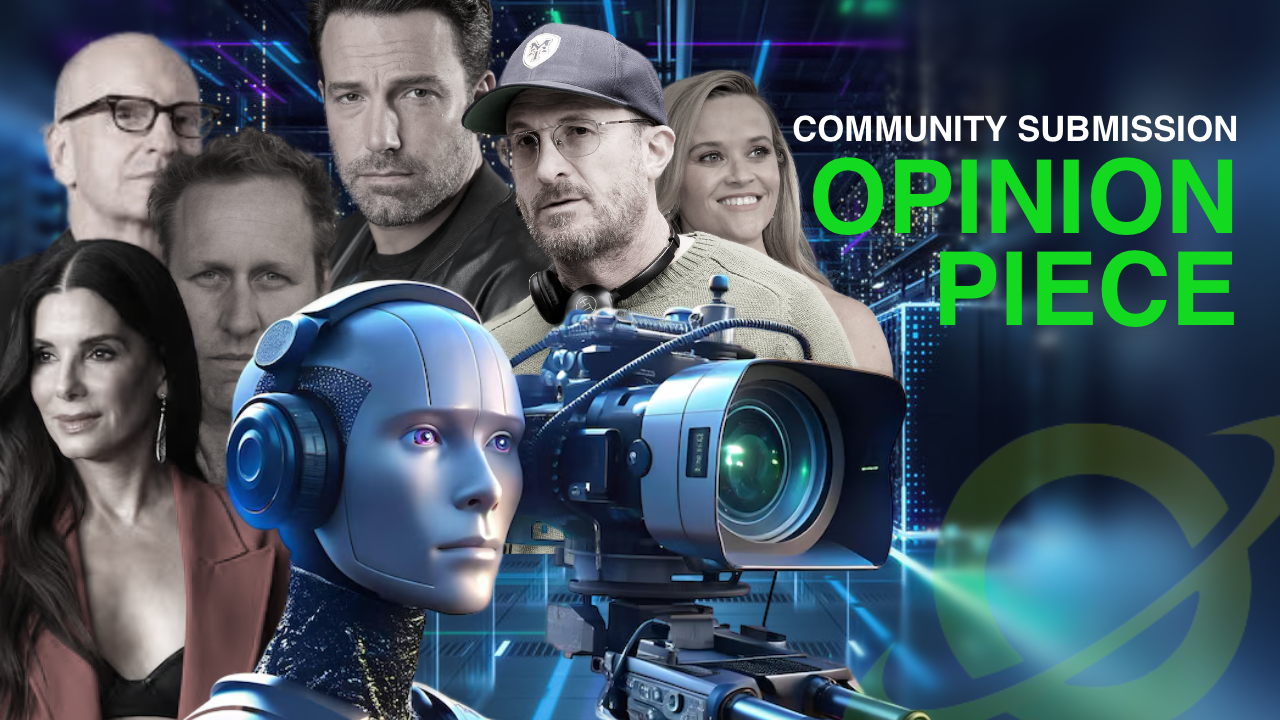
I read an article in The Guardian this morning with the headline “Why are respected directors suddenly embracing AI?” In the context of other recent headlines naming Sandra Bullock and Reese Witherspoon as seemingly announcing their support of AI in films, I’m left asking — what’s actually going on here?
The Guardian piece, as it turns out, didn’t say much. Some directors are using it and supporting it, others are not. Sandra and Reese get a swipe too, without the writer addressing the fact that SAG members won real protections around the use of their human likeness in the 2023 strikes. Perhaps that’s why they’re a bit more optimistic as the conversation about AI’s role in filmmaking gets louder, and more confusing.
So let’s look at what else is happening. Back in February, the CEO of Runway – a pure AI-focused production company – put forward the idea that instead of spending $100 million on one film, you should make 50. That same month, Roger Avary (co-writer of Pulp Fiction) announced he has three AI-driven films in production, expressing frustration in the current model to get his films made. Then in early March, Netflix trumpeted its acquisition of Ben Affleck’s company Interpositive — a company that says it’s about the enhancement of post-production, but what it’s really doing is likely trying to squeeze below-the-line costs during production.
Three conflicting approaches, and they could all be fundamentally right. We either let generative AI make the movies for us, blend the technology with traditional physical production or make a conscious decision not to use it at all – which, to be fair, is only going to get harder and harder to avoid. The factor driving all three approaches is undeniably cost. Budget bloat in the global film and television industry is the greatest structural threat to our industry and AI is going to be the scalpel.
This conversation isn’t about a creative revolution – it’s about an economic correction.

That doesn’t mean an impending collapse of the industry as we know it. AI, like the emergence of animation and gaming, will undoubtedly create a new genre of content. We will begin to see more content entirely generated by AI – building and creating worlds and characters like Mickey Mouse and Lara Croft. We will see these stories permeate TikTok and Instagram in much the same way we engage with traditional content. That’s not a bad thing. It equally doesn’t mean that generative AI content is going to be any better than traditionally made content. Generative AI still requires human curatorial input.
Where the divide exists between AI-generated content and the status quo is that the star of your AI show doesn’t turn up to a red carpet event or feed the wider machinations of commerce that prop up the traditional ecosystem.
An argument that supports the status quo – with AI becoming an enhancer to the craft rather than an outright threat – is that people are still exceptionally valuable. People, their ideas, their flaws, their successes and failures: we will still want to engage with other content, newspapers, magazines, podcasts, where we want to understand someone’s story or perspective or see photos of them wearing something iconic or mad from the Met Gala. These outlets need real humans to support their conversations from those in front and behind the screens of our productions. AI will undoubtedly assist in how that content is created and published but people still want to watch, and listen to and see, real-life humans.
What is absolutely certain, is that physical production is going to change. We will not require as many people to make a feature film or a long-form series as we currently do. Production budgets will inevitably force the hand of our industry. We’re kidding ourselves if, like lawyers, we can’t see the writing on the wall. The legal profession is currently wrestling with the AI reckoning — the cost-versus-benefit equation of their current service exposed in an environment where, with the correct prompts, Claude or ChatGPT can produce a passable boilerplate legal document as enforceable as one from Last Name, Last Name & Last Name. With that said, the legal profession is fundamentally about relationships, not the Word document — and the same principle applies to filmmakers and their content and the audience they are serving.
And this matters more here, in Aotearoa, than most places. New Zealand’s screen industry has been built on and become reliant on, a pure service model – we make other people’s films, on other people’s budgets, with crews scaled to international blockbusters. That model is exactly what AI is going to compress first. When a $200m production becomes a $90m one, the early casualties aren’t the director or the lead cast, it’s the scale of the international shoot. That’s not a hypothetical for us, it’s the next five years.
Which means the conversation our industry bodies and the production sector need to be having right now, isn’t whether to engage with AI — it’s understanding where our actual competitive advantage sits in a market that’s about to look very different. Is it premium physical production for filmmakers who want the real thing? Domestic content with cultural specificity AI can’t replicate? Hybrid workflows we can adopt faster than larger markets because we’re small enough to move? We don’t get to wait for Hollywood to figure this out and tell us what it means for us. By then the work will already be somewhere else.
This contraction will hurt people, and that matters. Crew who built careers on the back of the current cost structure will feel this first and hardest, and the industry owes them a real conversation about what comes next. But we shouldn’t lament the loss of jobs that only existed because the industry tolerated budget expansion for arguably modest returns. That capital discipline was always going to come — AI has just brought it forward. We should be looking at the wider opportunities this new frontier is opening up and having honest conversations about how we redeploy talented crew into new and emerging areas of the business and forging our own pathway. The worst thing we can do is slam the door on AI or ignore the conversation entirely, simply because it’s too scary.
The longer we stand at the edges of change, the less prepared we are when it finally arrives.
Shared with permission from the author.
Read the original article here and share your thoughts.
If you’d like to submit an opinion piece, please contact stan@shownews.co.nz